
Over the past week, it has been nearly impossible to escape the news of Jensen Huang’s abrupt exit from Nvidia, after reports of a string of affairs, including an alleged relationship with a suspected Chinese spy. It’s easy to see why the story has dominated headlines. Nvidia is one of the most valuable companies in the world and the engine of an AI boom that has reshaped markets on a scale not seen since the dotcom era. That makes Huang one of the most prominent CEOs ever to lose his job over a scandal, but he is far from the only one. In 2018 alone, at the height of the #MeToo movement, 17 CEOs of S&P 1500 companies left over misconduct, including the heads of Intel, CBS, and Wynn Resorts.
In total, the team at TradingPlatforms.io identified 146 cases between 2005 and 2024 in which the CEO of an S&P 1500 company left over misconduct, using the CEO Dismissal Database compiled by Gentry, Harrison, Quigley, and Boivie. We checked each case against the company’s SEC filings to measure how long boards took to name a permanent successor, where they found them, and how often the interim CEO kept the job. We then compared the findings with the latest Kalshi odds to see whether bettors’ expectations match what history suggests.
Nvidia Has Already Missed the Fast Route
Company boards often move fast when a CEO leaves in disgrace. In 71 of the 146 cases we analysed, the board skipped the interim stage entirely and named a permanent successor on the same day, usually a senior executive or a board member. Fast food chain McDonald’s did exactly this in 2019, replacing Steve Easterbrook with Chris Kempczinski the day his exit was announced.
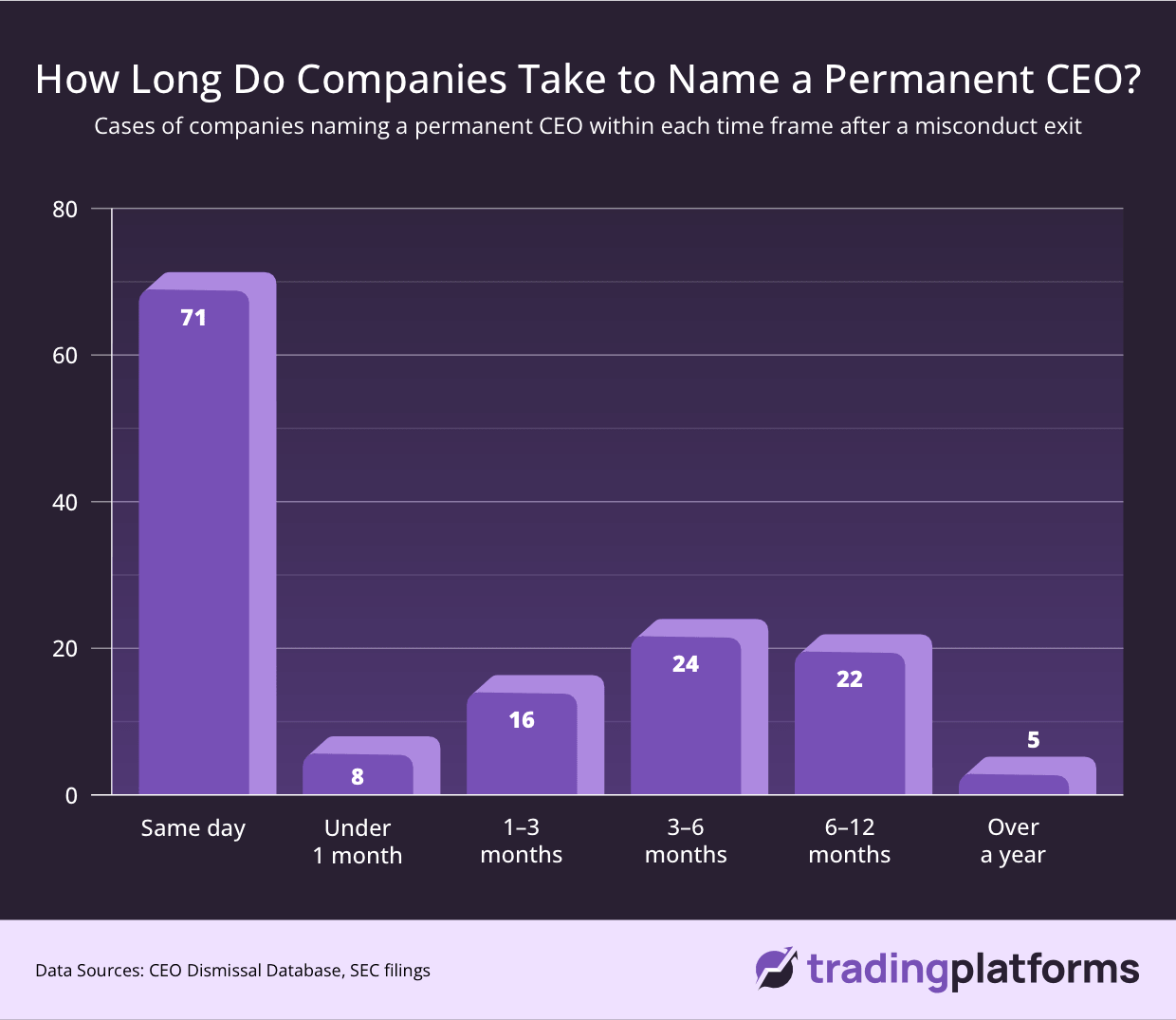
When boards don’t appoint a successor immediately, the search usually takes months. Only 8 companies found a new CEO within a month, such as Chemours, a Delaware-based chemicals company that named interim chief Denise Dignam permanent CEO just 23 days after putting Mark Newman on leave over an accounting probe in 2024. Another 16 companies took between one and three months. At WWE (World Wrestling Entertainment), it took 35 days for Stephanie McMahon to go from interim chief to co-CEO after her father Vince stepped down amid a misconduct investigation in 2022.
The most common outcome was a search of three to six months, which happened in 24 cases, while another 22 companies took between six months and a year. Five took more than a year to find a permanent successor, with retailer The Children’s Place holding the record: it ran with an interim CEO for 809 days after Ezra Dabah was pushed out in 2007, before finally hiring Lord & Taylor’s Jane Elfers.
Nvidia’s board didn’t appoint a permanent CEO on day one either. It named CFO Colette Kress interim CEO and hired executive search firm Heidrick & Struggles on November 17. Among companies that, like Nvidia, put an interim CEO in charge, the median search took 146 days, meaning that if Nvidia’s board follows the same pattern, a new CEO would be named around April 7, 2027, counting from Huang’s November 12 exit.
The World Expects a Much Faster Search
People seem to be far more optimistic about Nvidia finding a permanent CEO earlier. On Kalshi, a U.S. prediction market where traders buy and sell contracts on real-world events, traders put the odds of Nvidia naming a permanent CEO before February 1, 2027 at 53%. However, when we look at real historical cases of CEOs stepping down due to scandals and boards putting an interim CEO in charge, just 25% named a permanent successor within the same time frame.
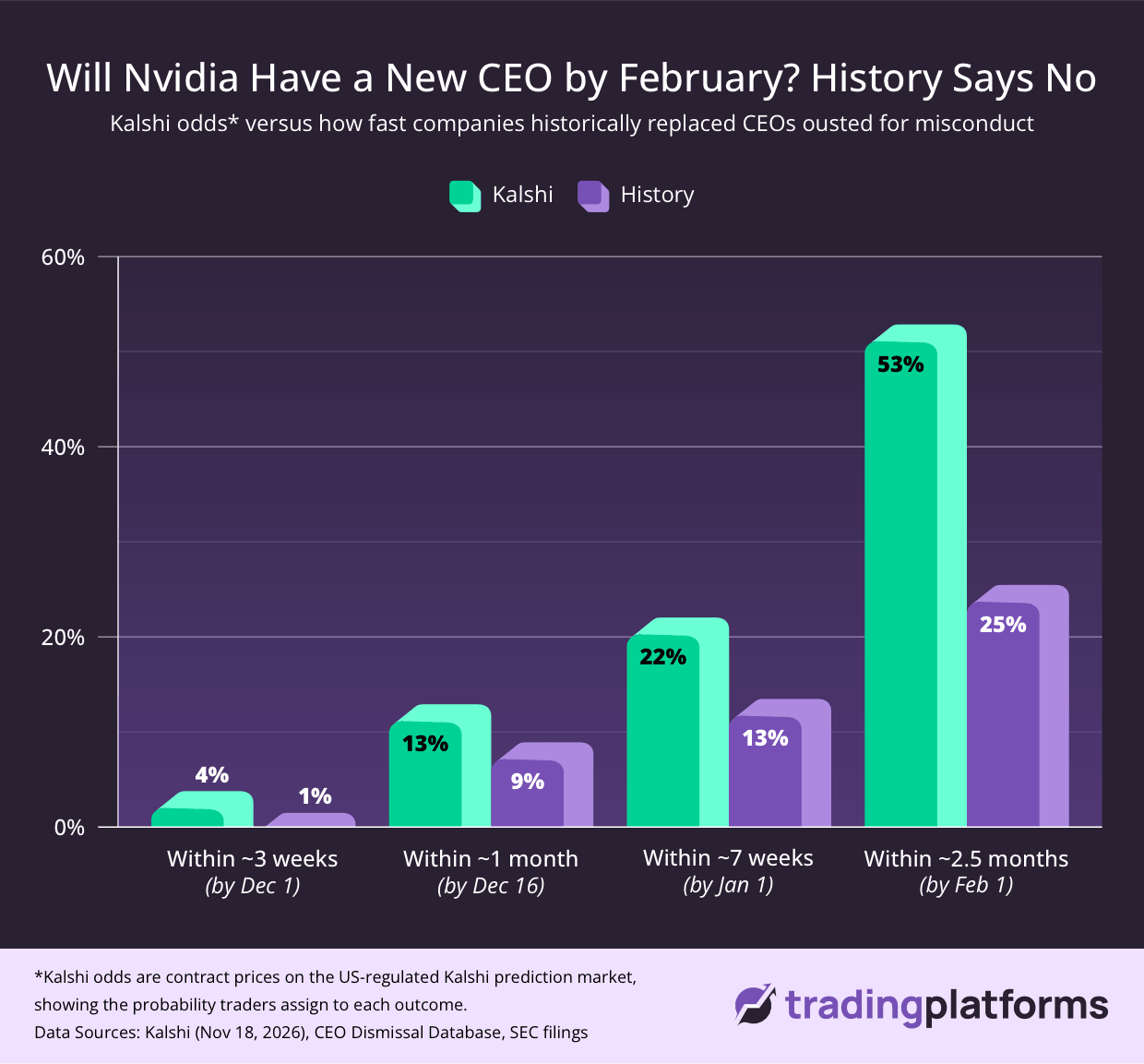
Still, the optimism isn’t entirely misguided. Nvidia has every incentive to end the uncertainty quickly, and with a search firm already on board and the board reportedly approaching candidates, the search appears to be already well underway.
Kress, Huang, or Someone Else? Where Will Nvidia’s Next CEO Come From?
Bettors’ current favourite is Arm Holdings CEO Rene Haas, who spent seven years at Nvidia before leaving in 2013. His odds on the prediction market Kalshi have climbed to 23% since reports emerged that Nvidia’s board and its newly hired headhunters had approached him about the job.
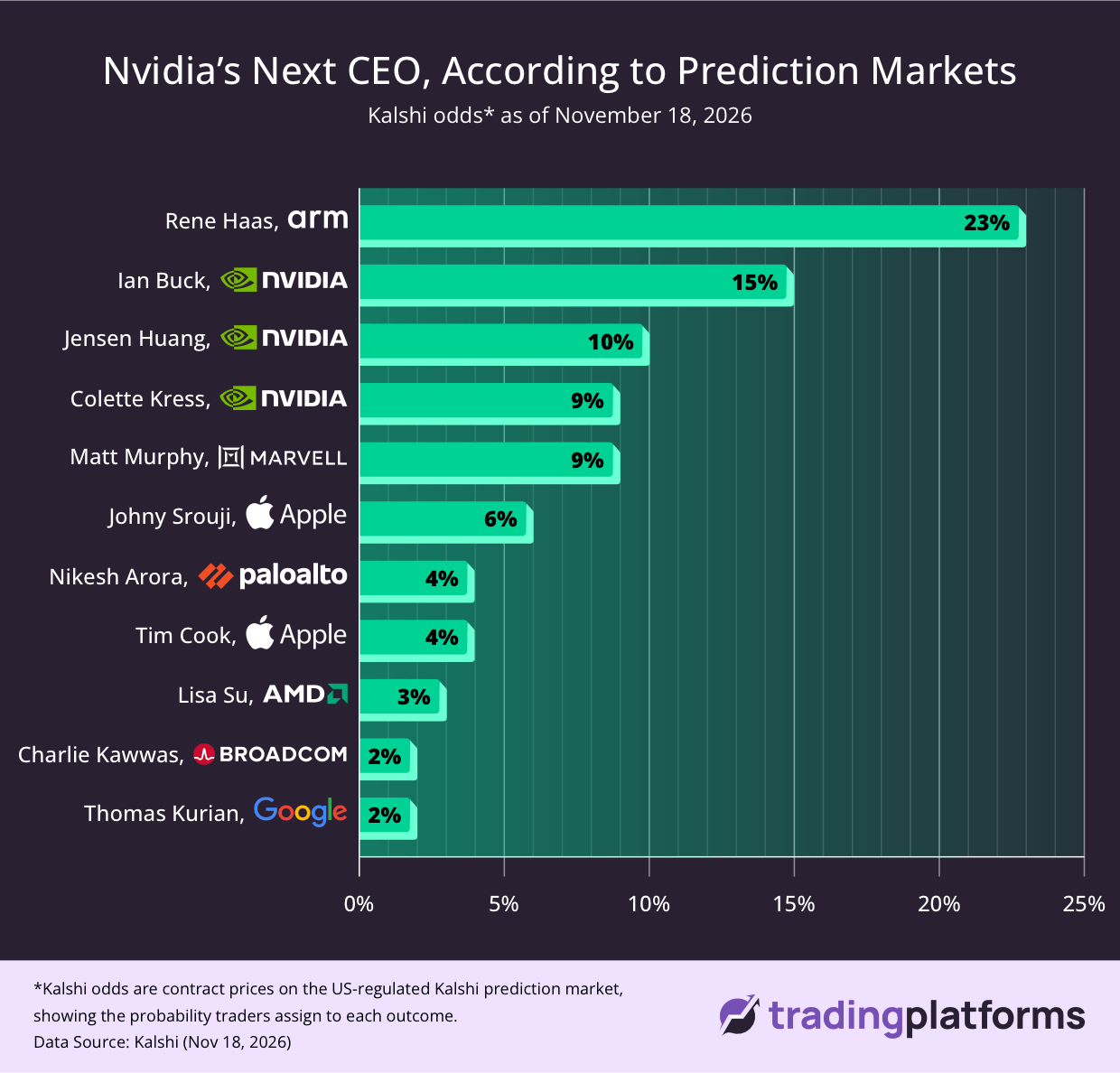
Close behind, at 15%, is Ian Buck, an Nvidia veteran who helped create CUDA, the software platform behind much of the company’s dominance. Buck was the clear favourite when Huang resigned, with odds of more than 40%, but has since slipped as attention has shifted to outside candidates.
Then there is Huang himself. A petition calling for his reinstatement has gathered more than 180,000 signatures. Elon Musk has signed it, and President Trump has said he would not oppose Huang’s return. Huang has said he would be honoured to come back, and Kalshi traders give him a roughly 10% chance of returning as CEO. Nvidia’s board chair, however, has since said the board does not intend to reinstate him.
Interim CEO Colette Kress, who has been Nvidia’s chief financial officer since 2013, sits at 9%, but history suggests bettors may be underrating her. Only 28% of interim CEOs in our data went on to get the job permanently, but those who were chief financial officers did far better, winning it in 4 of 8 cases. The closest parallel is Intel. When Brian Krzanich resigned in 2018 over a past relationship with an employee, CFO Bob Swan stepped in as interim CEO and was given the job permanently 223 days later.
Further down the list is Tim Cook (4%), Apple’s executive chairman, who ran the iPhone maker for well over a decade and whom Trump publicly named as the only man capable enough to replace Huang. AMD CEO Lisa Su (3%) would be the most dramatic pick of all. She has spent more than a decade turning AMD into Nvidia’s biggest rival in AI chips, and she is also Huang’s first cousin once removed, despite the two having reportedly never shared a family dinner.
Are Bettors Right To Favour An Outsider Over The People Running Nvidia Today?
Looking at every case in the data, it seems like a long shot. When a CEO was forced out over misconduct, boards usually turned to someone close to home: 77 successors were executives at the company, and 26 were existing board members, against 43 outside hires.
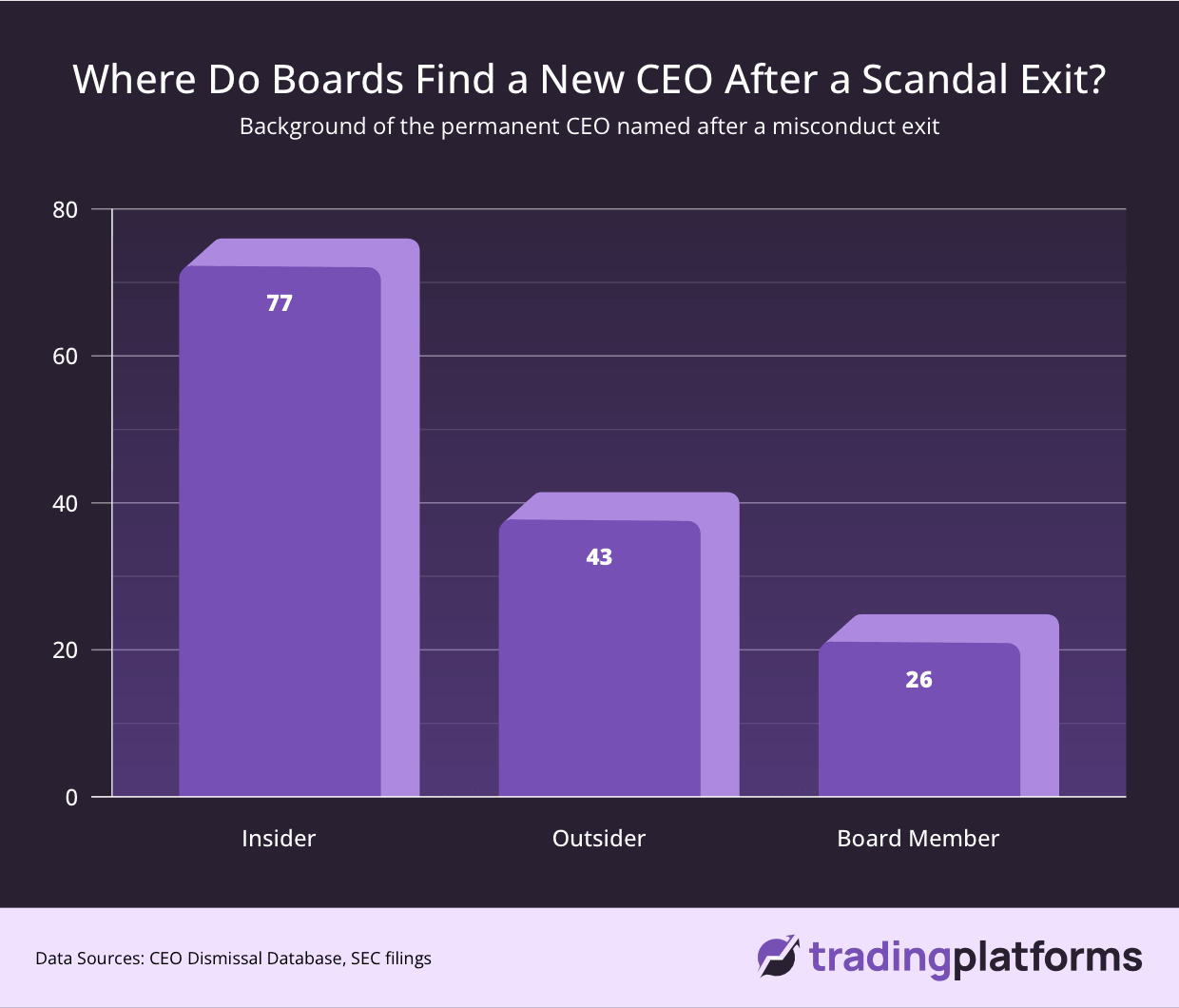
Those figures, however, include the many boards that named a permanent successor on the day of the exit, and those boards almost always promoted from within. Among the companies that put an interim CEO in charge, more than half (54%) ended up hiring an outsider as permanent CEO.
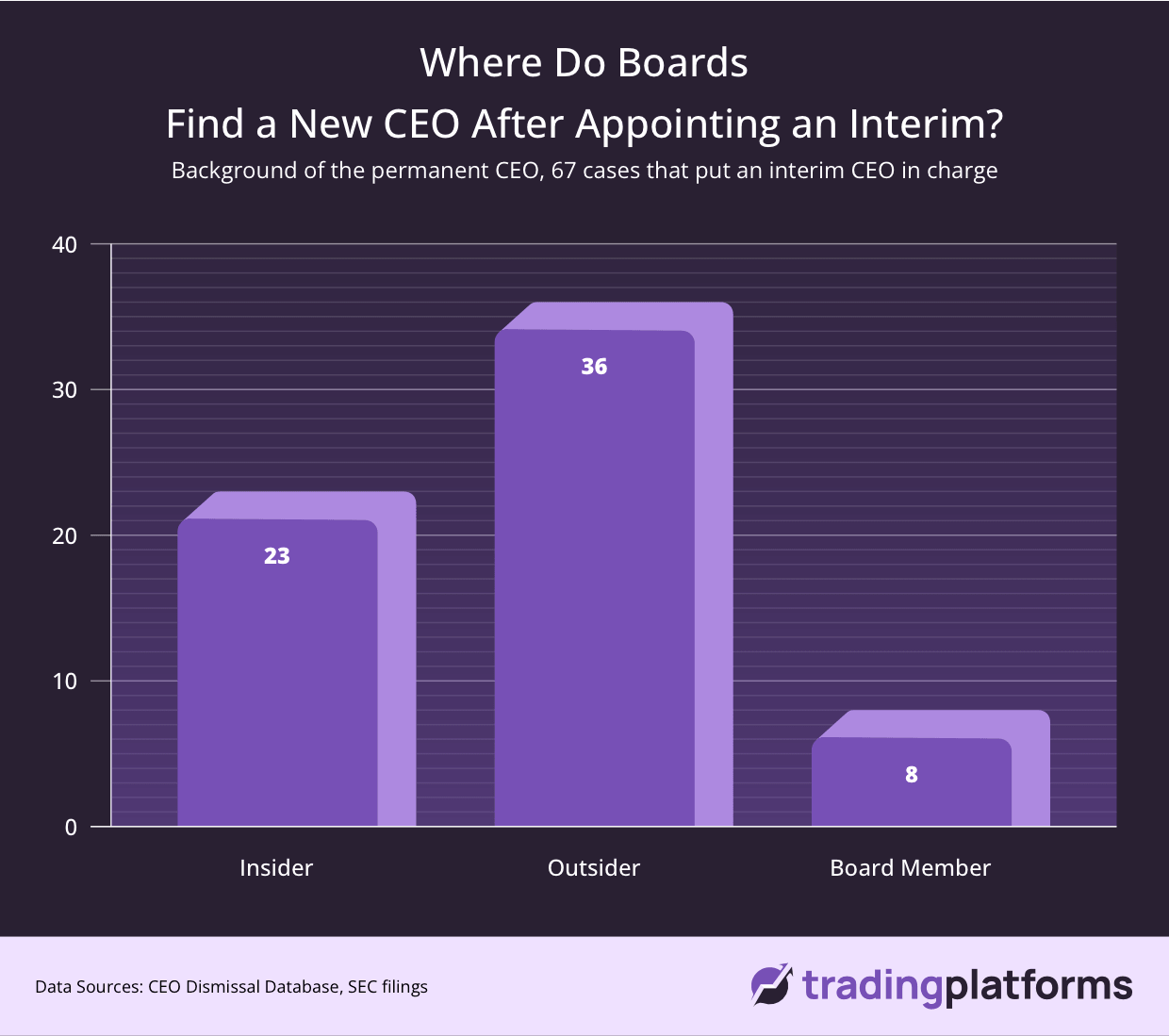
Best Buy did exactly that in 2012, bringing in Hubert Joly from outside the company four months after Brian Dunn resigned amid an investigation into his relationship with an employee. HP went the same way in 2010, naming former SAP chief Léo Apotheker less than two months after Mark Hurd’s exit. If Nvidia follows that pattern, the odds tilt against insiders like Ian Buck and point towards an outside name, whether that’s Rene Haas, Marvell’s Matt Murphy or Apple’s Johny Srouji.
A Special Case
If history is any guide, Nvidia will most likely name a permanent CEO next spring, and that person will most likely come from outside the company. Bettors agree on the outsider but expect a faster decision, giving good odds of an announcement before February. A Huang comeback, meanwhile, now looks unlikely. Not one of the 146 ousted CEOs in our data was rehired, and on Nvidia’s first earnings call since his exit, board chair Harvey Jones said the board does not intend to reinstate him.
Nvidia, however, is unlike almost any other company. It sits at the very heart of the global AI race, and its CEO search is playing out amid political pressure, a federal investigation and a public campaign for Huang’s return. The board itself is pulling in two directions: Jones said it wants a permanent CEO in place as quickly as possible, but won’t rush until it finds exactly the right person. Nvidia’s strong results may ease some of the pressure. The company beat expectations with $115.8 billion in quarterly revenue, and Kress told analysts it was ‘business as usual’ in her first earnings call as interim CEO.
Methodology
To analyse how companies replace CEOs who leave over misconduct, the team at TradingPlatforms used the CEO Dismissal Database compiled by Richard Gentry, Joseph Harrison, Timothy Quigley and Steven Boivie, which covers CEO departures at S&P 1500 companies. We selected all departures the researchers classified as dismissals over legal violations or ethical concerns (departure code 4) between fiscal years 2005 and 2024, giving 158 cases with exits announced between late 2004 and 2025. Twelve cases were excluded because the company was acquired or went bankrupt before a permanent successor was named, leaving 146.
We verified each case against the company’s Form 8-K filings with the US Securities and Exchange Commission. The exit date is the date given on the filing that first announced the CEO’s departure, and the successor date is the date given on the filing that announced a permanent replacement. Where both appeared in the same filing, the wait was counted as zero days. We used announcement dates throughout, not the dates new CEOs took office. A company was counted as appointing an interim CEO only where someone held an interim or acting CEO title.
Successors were classified by their role before any interim stint: company executives (including executive chairmen and returning former employees), existing non-executive board members, and outsiders. In the article, executives and board members together are described as successors already at the company.
Kalshi odds were recorded on November 18, 2026. To compare them with history, we calculated the share of the 67 interim cases in which a permanent CEO was announced within the same number of days, counting from Huang’s exit on November 12, 2026. All waiting times measure the gap to a public announcement and may not reflect how long boards spent searching in private.