
The launch of the Nissan Leaf in 2010 and the Tesla Model S in 2012 marked the beginning of the mass-market shift towards electric vehicles, a transformation that has since reshaped the global automotive industry. As EV adoption accelerates, however, the expansion of charging infrastructure has become increasingly important to supporting drivers and ensuring the EV transition continues smoothly. This, however, raises an important question: which countries have built the most extensive public charging networks, and where is charging infrastructure struggling to keep pace with EV adoption?
To answer these questions, the team at TradingPlatforms analysed the latest data on electric vehicle stocks and public charging points from the International Energy Agency’s (IEA) Global EV Outlook 2026. We compared EV numbers with public charging infrastructure across countries to identify where charging networks are keeping pace with growing EV fleets and where the gap between the two is widening.
Where Is EV Charging Infrastructure Under the Most Pressure?
The pressure of the growing fleets of electric vehicles is most severely felt in several small EV markets, where electrification and green projects have only recently begun to accelerate. South America’s Uruguay has the highest number of electric vehicles per public charging point among the 46 countries analysed, with around 162 EVs for every public charger in 2025. This is a direct result of the 2022 tax decree that eliminated import duties and excise tax on EVs, helping the country’s EV fleet to more than double from 11,250 in 2024 to 25,900 in 2025. At the same time, the public charging network increased by just 14.3%, from 140 to 160 charging points over the span of a year.
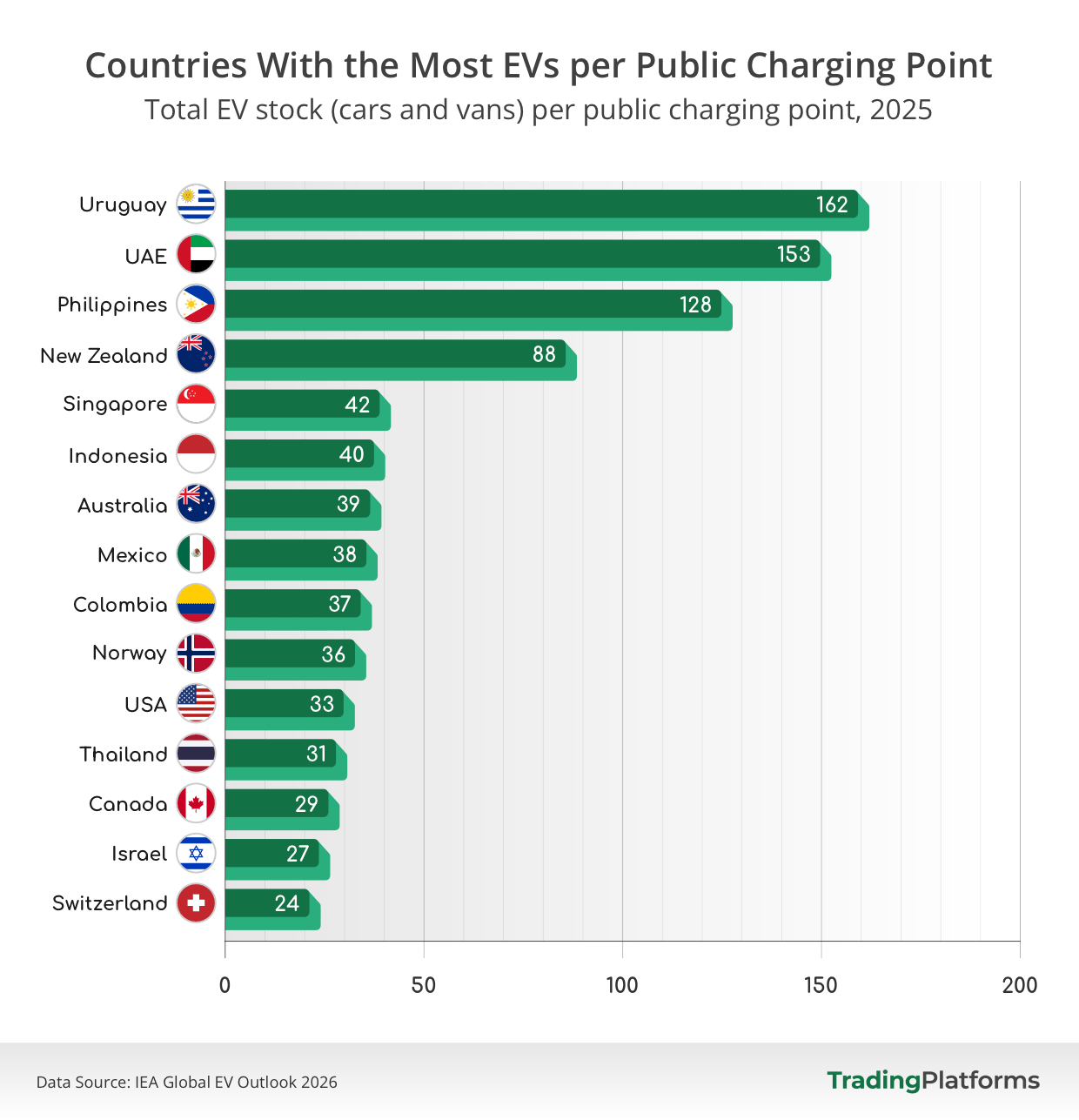
The United Arab Emirates has the second-highest imbalance, with around 153 EVs per public charging point in 2025. Much of this comes down to regulation. Independent operators were only permitted to build public charging stations from 2024, after years in which expansion ran almost entirely through state utilities. The network is now growing rapidly, but it is going to take time before it can catch up to the country’s 213,000-strong electric vehicle fleet.
Then there is the Philippines. The country’s 2022 Electric Vehicle Industry Development Act was intended to support the development of the EV industry, but the country’s fleet has grown much faster than its public charging network. EV numbers surged from just 4,830 in 2024 to 35,035 in 2025, marking a more than sevenfold increase.The charging network, meanwhile, didn’t move. The result was a jump from around 18 EVs per charger to 128 in just one year.
New Zealand also faces considerable pressure in providing adequate infrastructure for its growing EV fleet, with approximately 88 EVs per public charger. The country’s government pledged NZ$257 million to fund 10,000 public chargers by 2030, but as of early 2026 the rollout had reportedly stalled without a single contract signed, leaving the public network short of the pace required to keep up with the rising number of electric vehicles across the country.
The USA and Canada are also experiencing EV-to-charger pressure. In the US, there are 33 EVs for every public charging point. The $5 billion NEVI programme, a federal initiative to build a nationwide network of fast EV chargers along major highways, was frozen for most of 2025, and fewer than 400 federally funded chargers were actually built.. Canada fares slightly better at 29 EVs per public charging point, but its problem is geography rather than simply the number of chargers: 88% of its charging points are concentrated in just three provinces, leaving rural and northern drivers more reliant on home charging, which many do not have.
Where Does Charging Capacity Keep Up With EV Demand?
At the other end of the ranking, South Korea leads the world in charging infrastructure, with just two electric vehicles for every public charging point. Its EV fleet grew by almost 30% between 2024 and 2025, rising from 767,000 to 994,000 vehicles over the year, while the number of charging points increased by around 74,000 to more than 491,000. Why are Koreans far ahead of everyone else? South Korea’s public charging network was built out ahead of demand, driven by a legal mandate requiring apartment complexes to install EV chargers in 5% of newly built parking spaces and in 2% of existing ones. Because most Korean citizens live in multi-family housing with limited or no off-street parking for home charging, public infrastructure has had to step up, giving Korea one of the highest levels of public charging availability relative to the size of its EV fleet.
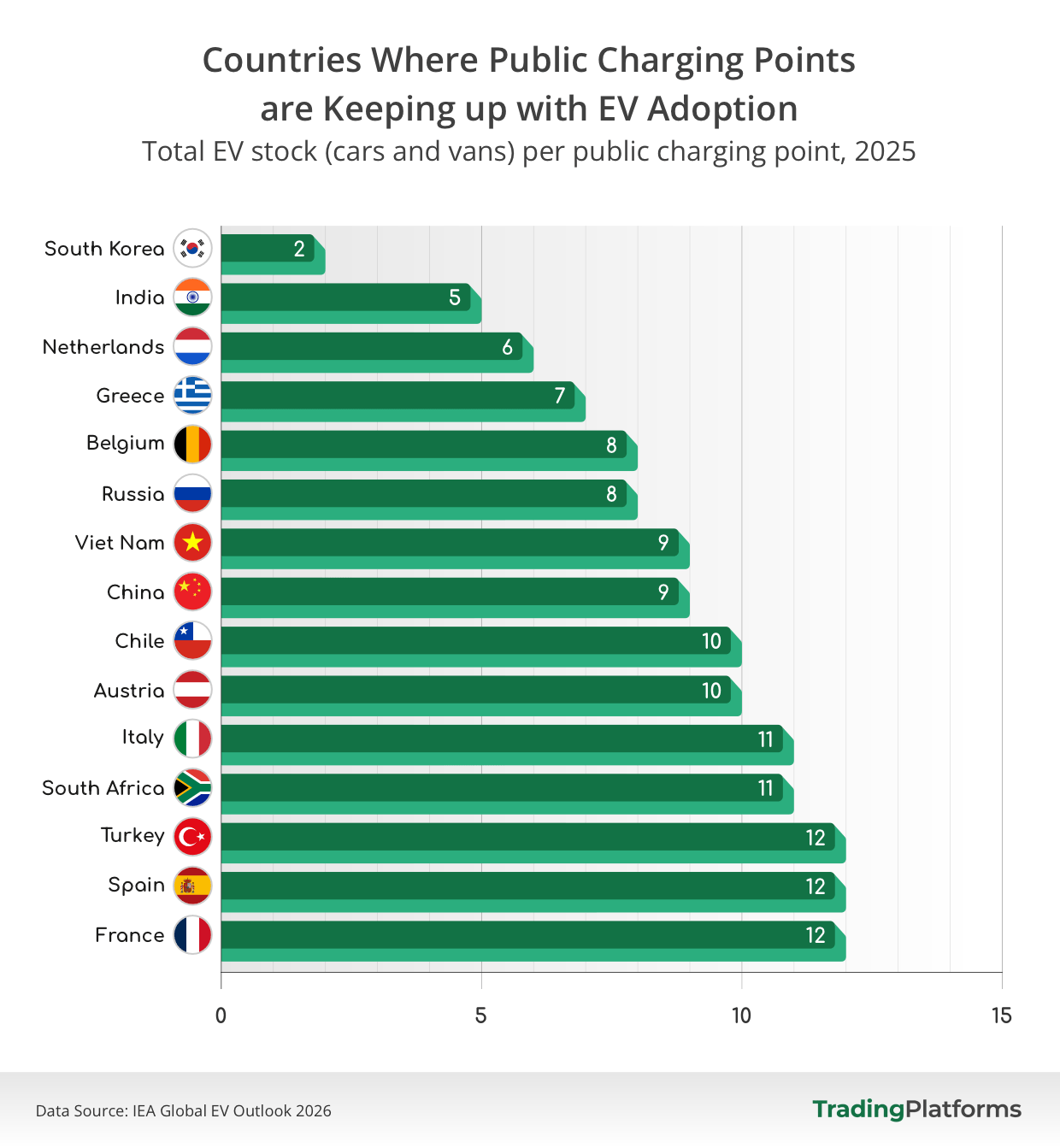
India is another notable example, with roughly five EVs per public charging point in 2025, despite its EV fleet expanding by more than 70% to 433,000 vehicles. This has been largely driven by the PM E-DRIVE scheme, launched in 2024 with roughly $240 million earmarked specifically for public charging stations, following on from the earlier FAME II programme.
China has also managed to keep infrastructure growth ahead of electric vehicle adoption despite operating at a vastly larger scale than any other country. The country’s EV fleet increased by more than 12 million vehicles, reaching a total of 44.4 million as of 2025, while the number of public charging points expanded by 42% to 4.68 million. As a result, China improved its ratio from nearly 10 EVs per charging point in 2024 to around nine in 2025. Viet Nam achieved a similar balance during a period of exceptionally rapid growth, with both its EV fleet and charging network expanding by more than 150%.
Several European countries also maintain relatively strong public charging availability. The Netherlands has around 6 EVs per public charging point, followed by Greece with 7 and Belgium with 8. Austria and France each have approximately 10 and 12 EVs per charger respectively, while Spain and Turkey both have around 12. Denmark, Sweden and Germany also improved their charging availability as charging infrastructure expanded faster than their EV fleets, demonstrating that European markets are continuing to build charging capacity ahead of demand.
South Africa and Chile also stand out among emerging markets, maintaining around 11 and 10 EVs per charging point, respectively, after significantly expanding their charging networks. These countries demonstrate that rapid EV adoption does not necessarily result in mounting pressure on public infrastructure when investment in charging capacity keeps pace with demand.
Where Do EV Drivers Have Access to the Most Charging Power?
Looking beyond the number of public charging points, the amount of charging capacity available relative to each country’s EV fleet provides another measure of infrastructure readiness. This metric – kilowatts (kW) of capacity per car – accounts for the power that charging networks can theoretically deliver, revealing differences that are not visible when comparing charger numbers alone. South Korea leads the countries analysed with an average of 9.2 kW of public charging capacity per EV, followed by India with 6.2 kW and China with 5.9 kW.
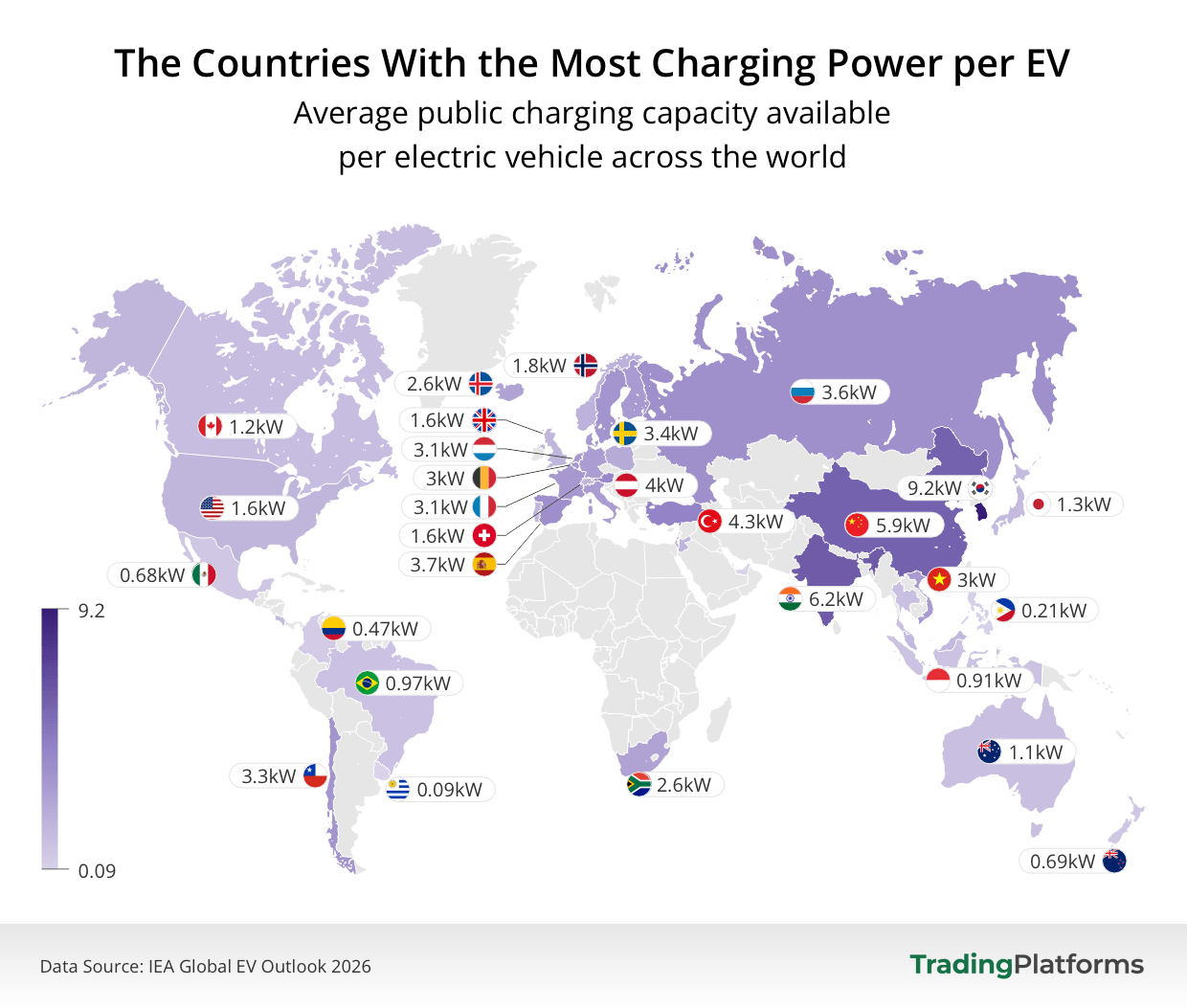
China’s position is particularly impressive given the sheer scale of its EV market. With more than 44 million electric vehicles on its roads as of 2025, the country still maintains one of the highest levels of charging capacity relative to fleet size. India achieves an even higher ratio despite its considerably smaller EV market, highlighting the significant investment both countries have made in public charging infrastructure.
Several European countries rank strongly for public charging capacity relative to their EV fleets. Austria emerges in a leading position with 4 kW of public charging capacity per EV, followed by Spain with 3.7 kW and Greece with 3.6 kW. Sweden provides 3.4 kW per EV, while France and the Netherlands each stand at 3.1 kW. Turkey, which spans both Europe and Asia, ranks even higher at 4.3 kW per EV. Europe’s relatively strong performance may partly reflect its denser populations, shorter distances between major cities, and sustained public investment in charging infrastructure, making it easier to build extensive networks that support both everyday driving and longer journeys.
The United States and Canada rank considerably lower, with just 1.6 kW and 1.2 kW of public charging capacity per EV, respectively. Australia’s ratio is similarly low at 1.1 kW per vehicle. While these figures suggest comparatively limited public charging capacity relative to the size of nationwide EV fleets, they do not necessarily reflect the charging experience of EV drivers. All three countries have large, geographically dispersed populations and substantial reliance on private home charging, which reduces the dependence on public infrastructure compared with more densely populated markets. However, their vast distances and lower population density also make building comprehensive public charging networks more challenging, particularly along long-distance travel routes.
At the other end of the ranking, the United Arab Emirates and Uruguay have the lowest levels of public charging capacity relative to their EV fleets, at just 0.096 kW and 0.092 kW per vehicle, respectively. The Philippines also ranks among the lowest with 0.21 kW per EV, followed by Colombia with 0.47 kW. The contrast between these countries and the leaders illustrates why charger counts alone can provide an incomplete picture of infrastructure readiness: a large network of lower-capacity chargers may offer considerably less charging power than a smaller network equipped with faster, higher-capacity infrastructure.
The Global EV and Charging Infrastructure Race
Southeast Asia is emerging as the world’s fastest EV-adopting region, led by the Philippines, where the total EV fleet expanded by 625.36% in a single year. Lao PDR followed at 184.68%, while Viet Nam grew 154.37% and Indonesia 136.57%. Cambodia, Malaysia and Thailand also recorded strong growth of 134.50%, 91.41% and 61.78%, respectively.
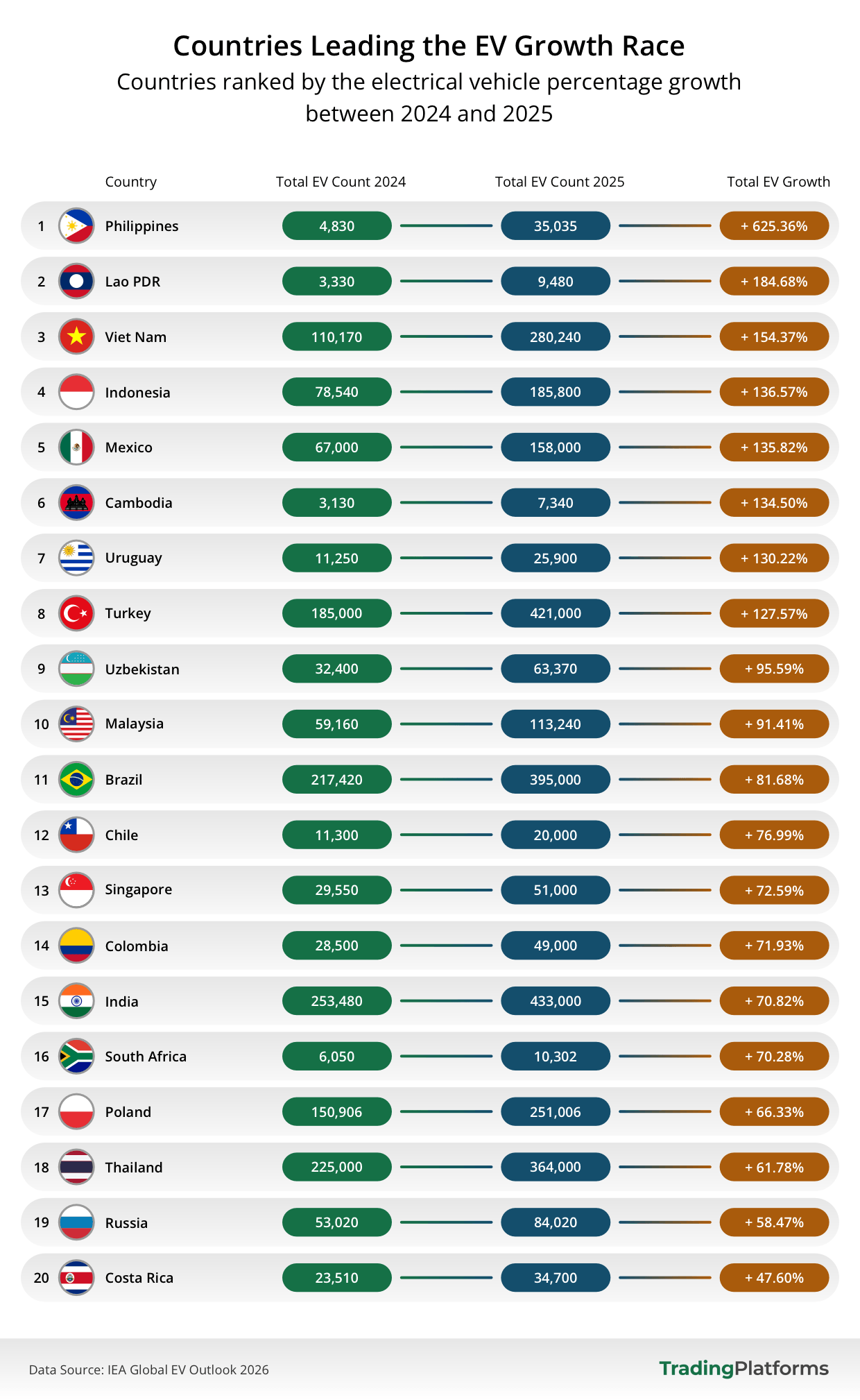
Increasing EV fleets are also widespread across Europe, although generally at a more measured pace. Poland recorded a 66.33% annual increase in the number of EVs on Polish roads, followed by Portugal at 37.73%, Spain at 39.10%, and Denmark at 45.86%. Belgium’s EV fleet expanded 32.52% and Sweden’s 19.89%, while the UK’s fleet increased 23.49% to more than 2.5 million vehicles in 2025. Among Europe’s largest markets, France saw its EV stock grow 17.33% annually to 2.35 million units and Germany – 16.47% to 3.22 million, while the Netherlands reached 1.25 million EVs on the road after growing 23.34% between 2024 and 2025.
Outside Europe and Asia, adoption is also accelerating across several major markets. Brazil’s EV fleet grew 81.68%, Colombia’s 71.93%, and Chile’s 76.99%, while India increased by 70.82% to 433,000 vehicles. Australia recorded 42.76% growth and Canada 19.26%. The United States, already home to one of the world’s largest EV fleets, grew 23.78% from 6.33 million to 7.84 million vehicles. China, however, remained by far the largest market, adding more than 12 million EVs in 2024 alone to reach 44.38 million electric cars and vans on the road – despite a seemingly smaller growth of 37.66%.
The Countries That Expanded Their Charging Infrastructure The Most in One Year
Public charging infrastructure expanded rapidly across several countries between 2024 and 2025, with Turkey recording the fastest growth among those analysed. The country’s network more than tripled from 11,900 public charging points in 2024 to 36,100 in 2025, an increase of 203%. Viet Nam and South Africa also saw exceptional growth, expanding their networks by 158% and 144% respectively, while the United Arab Emirates more than doubled its number of charging points.
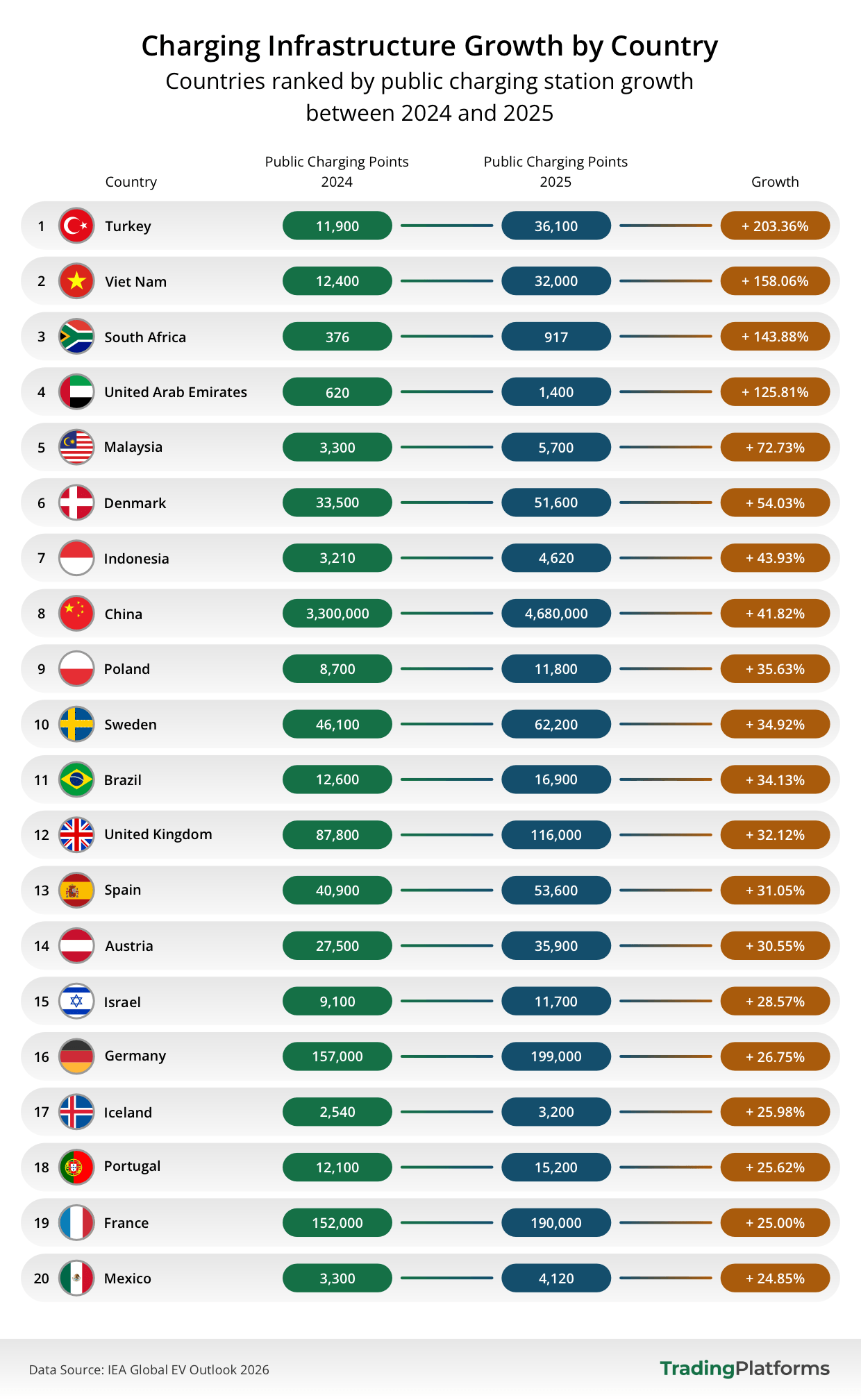
Several Asian markets also recorded strong infrastructure growth as EV adoption accelerated. Malaysia expanded its charging network by nearly 73%, while Indonesia increased its number of public charging points by 44%. China, meanwhile, added more charging points than any other country by a considerable margin, expanding its already vast network by 1.38 million chargers to reach 4.68 million in 2025. Its charging infrastructure grew faster than its EV fleet, allowing China to slightly improve charger availability despite adding more than 12 million electric vehicles.
Europe also continued to significantly expand its public charging infrastructure, with Denmark leading the region after increasing its network by 54% to 51,600 charging points. Sweden, Poland, the United Kingdom, and Spain all recorded growth of more than 30%, while Germany added 42,000 charging points and France added 38,000. This continued expansion suggests that several of Europe’s largest EV markets are increasingly investing in infrastructure to keep pace with the growing number of electric vehicles on their roads.
Which Countries Have the Fastest Charging Networks?
The number of public charging points alone does not tell the full story about the quality of a country’s EV infrastructure. Charging speed is equally important, particularly for drivers who cannot charge at home or need to recharge quickly during longer journeys. A country may have an extensive network of public chargers, but if most are slow, drivers can still face long waiting times and inconsistent charging. By contrast, a smaller network with a high proportion of fast and ultra-fast chargers can provide greater flexibility and allow more vehicles to be served throughout the day.
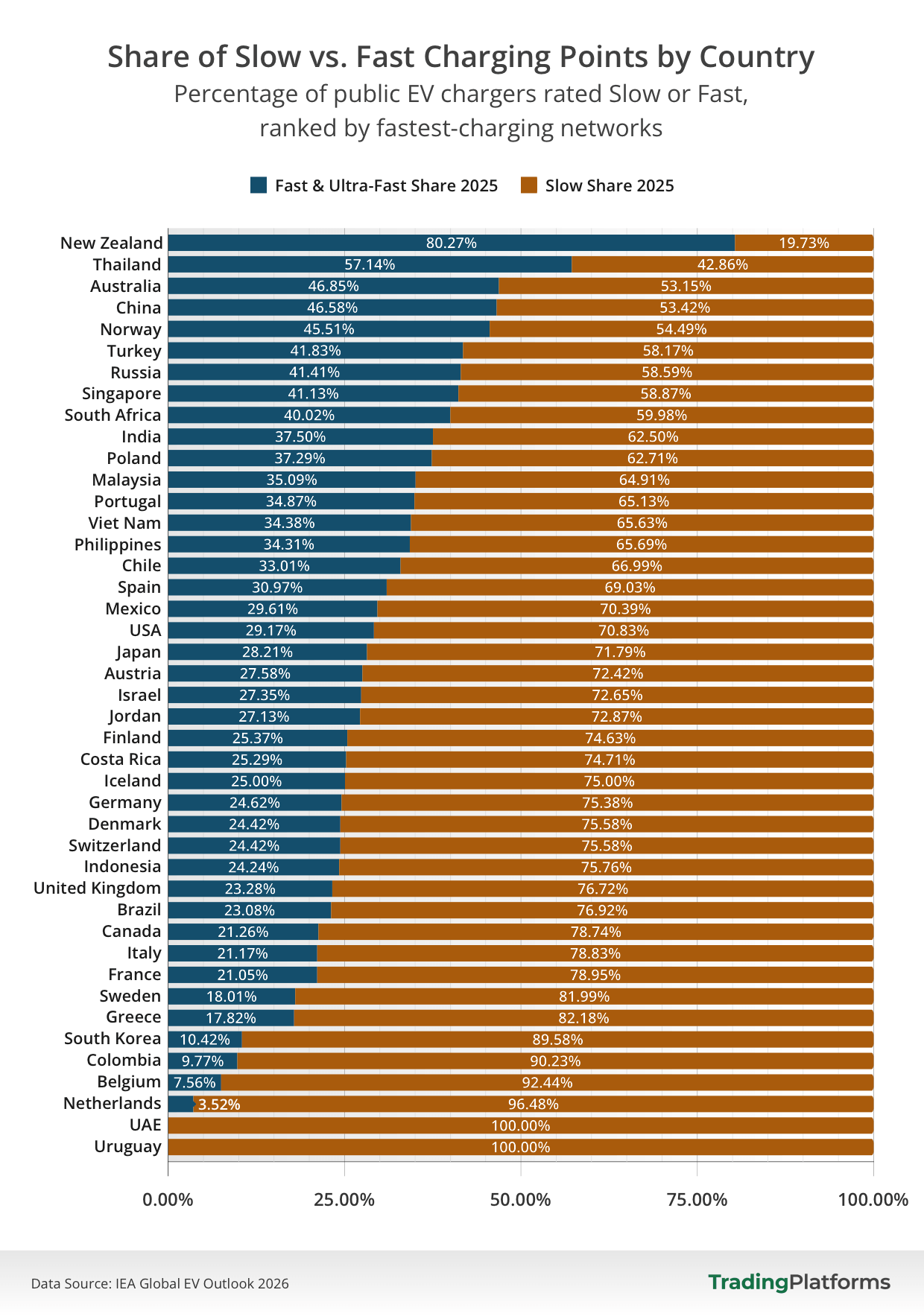
New Zealand has the fastest charging network among the countries analysed, with fast and ultra-fast chargers accounting for more than 80% of its public charging points in 2025, up from 76% a year earlier. Thailand follows with 57% of its network consisting of fast or ultra-fast chargers, while Australia, China and Norway each have more than 45% of their public charging infrastructure in these higher-speed categories. Several countries also made significant progress in shifting their networks towards faster charging, including the Philippines, where the share of fast and ultra-fast chargers more than doubled from 16% in 2024 to 34% in 2025.
At the other end of the ranking, public charging networks in several countries remain overwhelmingly dominated by slower chargers. The Netherlands had just 3.5% of its public charging network made up of fast or ultra-fast chargers in 2025, followed by Belgium with 7.6% and Colombia with 9.8%. Meanwhile, the United Arab Emirates and Uruguay’s network consisted entirely of slow chargers, highlighting how a large number of charging points does not necessarily translate into a fast or convenient charging experience for EV drivers.
The Global EV Charging Race Is Becoming a Race Against Time
As more drivers switch from petrol and diesel vehicles to electric cars, the focus is increasingly shifting from convincing drivers to ditch their polluting diesel and gasoline cars to providing adequate public charging to sustain a growing EV fleet. Countries such as Korea, India, and China show what happens when charging capacity grows alongside EV growth, while Uruguay, the UAE, and the Philippines illustrate the strain that can emerge when infrastructure falls behind. In the Philippines alone, the EV fleet surged more than sixfold in a year while its public charging network barely changed.
The next phase of the EV transition will therefore depend not just on how many electric vehicles countries put on their roads, but on how quickly they can build the infrastructure needed to support them. The countries best positioned for continued EV growth will be those that can expand charging availability, capacity and speed alongside, or ahead of, their growing electric vehicle fleets.
Methodology
To analyse global EV charging infrastructure, the team at TradingPlatforms used data from the International Energy Agency’s Global EV Outlook 2026, covering electric vehicle stock and public charging infrastructure in 2024 and 2025.
Electric vehicle stock includes battery electric vehicles (BEVs) and plug-in hybrid electric vehicles (PHEVs). Fuel cell electric vehicles (FCEVs) were excluded, as they rely on hydrogen refuelling rather than public charging infrastructure. Vehicle stock includes passenger cars and, where reported by the IEA, light-duty commercial vans. As van-level data was unavailable for some markets, totals for these countries reflect passenger cars only.
We calculated the number of EVs per public charging point in each country for 2025 to assess relative pressure on charging networks and compared these figures with 2024 data to measure year-on-year changes in EV stock and charging infrastructure. Countries without available 2025 charging point data were excluded from these calculations, including Cambodia, Lao PDR and Uzbekistan.
To assess charging infrastructure beyond the number of available points, we also used the IEA’s breakdown of public chargers by speed tier (Slow, Fast and Ultra-Fast) to calculate the share of Fast and Ultra-Fast chargers, and average public charging capacity in kilowatts per EV.
In total, 46 countries with available data were analysed. Unless otherwise stated, all figures reflect the most recently reported year in the IEA Global EV Outlook 2026 dataset: 2025.