 Martin Tunchev is a Data Research Lead at TradingPlatforms.io, where he focuses on producing data-driven research and in-depth reports covering financial markets, the global economy, technology, education, and wider social and economic trends. He specialises in analysing complex datasets, identifying meaningful patterns, and turning them into clear, accessible insights for readers.

Work is one of the oldest exchanges in human society: time, skill, and effort traded for the means to live. But the reward for that exchange has always depended on the economic conditions of the time. It shifts with labour markets, prices, politics, and the fortunes of the people on either side of the paycheque.
At the very bottom of that system sits a number designed to draw a line in the sand. A minimum wage is supposed to be the floor beneath a worker’s earnings – the point below which pay should not fall. Yet that floor has been rising at very different speeds across Europe, reshaping the continent’s lowest legal pay from one year to the next. In this context, the team at TradingPlatforms compared gross minimum wages in 29 European countries as of July 2016, 2025, and 2026 to measure how much statutory pay has changed over the past decade and identify which economies have moved furthest up the wage scale.
We found that in Europe, the pace of change and the level of pay do not always move together. Some of the sharpest increases have come in countries like Albania and Moldova, where minimum wages remain among the lowest on the continent, while higher wage floors in places like Luxembourg and France have generally risen more slowly. That leaves Europe with a wage map that has evolved considerably, but still reflects the economic divides that existed a decade ago.
Key takeaways
- Luxembourg and Ireland have the highest minimum wages in Europe at €2,771 and €2,391 per month, respectively, while Moldova and Ukraine sit at the bottom at €313 and €169.
- Albania recorded Europe’s biggest annual increase, with its minimum wage rising 30.15% from €408 to €531, while Poland saw the smallest change at 1.73%. Montenegro was the only country with no change, keeping its minimum wage at €670.
- Despite having Europe’s second-lowest minimum wage, Moldova recorded the biggest growth over the past decade, with its statutory floor surging from €45 in 2016 to €313 in 2026 – a 595.6% jump when converted to euros.
- Turkey saw the smallest wage gain since 2016, with its minimum rising from €514 to €621, yet it jumped 11.3% in the past year alone.
How Did Europe’s Minimum Wage Take Shape?
Minimum wages have become a central part of Europe’s labour markets, but they were not introduced everywhere at the same time. France established a national minimum wage in 1950, while many European countries introduced statutory wage floors decades later as governments sought to protect the lowest-paid workers. Today, most European countries have a national minimum wage, although several – including Denmark, Italy, Austria, Finland, and Sweden – set minimum pay primarily through agreements between employers and trade unions. The result is a continent where minimum pay is shaped by very different systems, making the pace and scale of change just as interesting as the wage levels themselves.
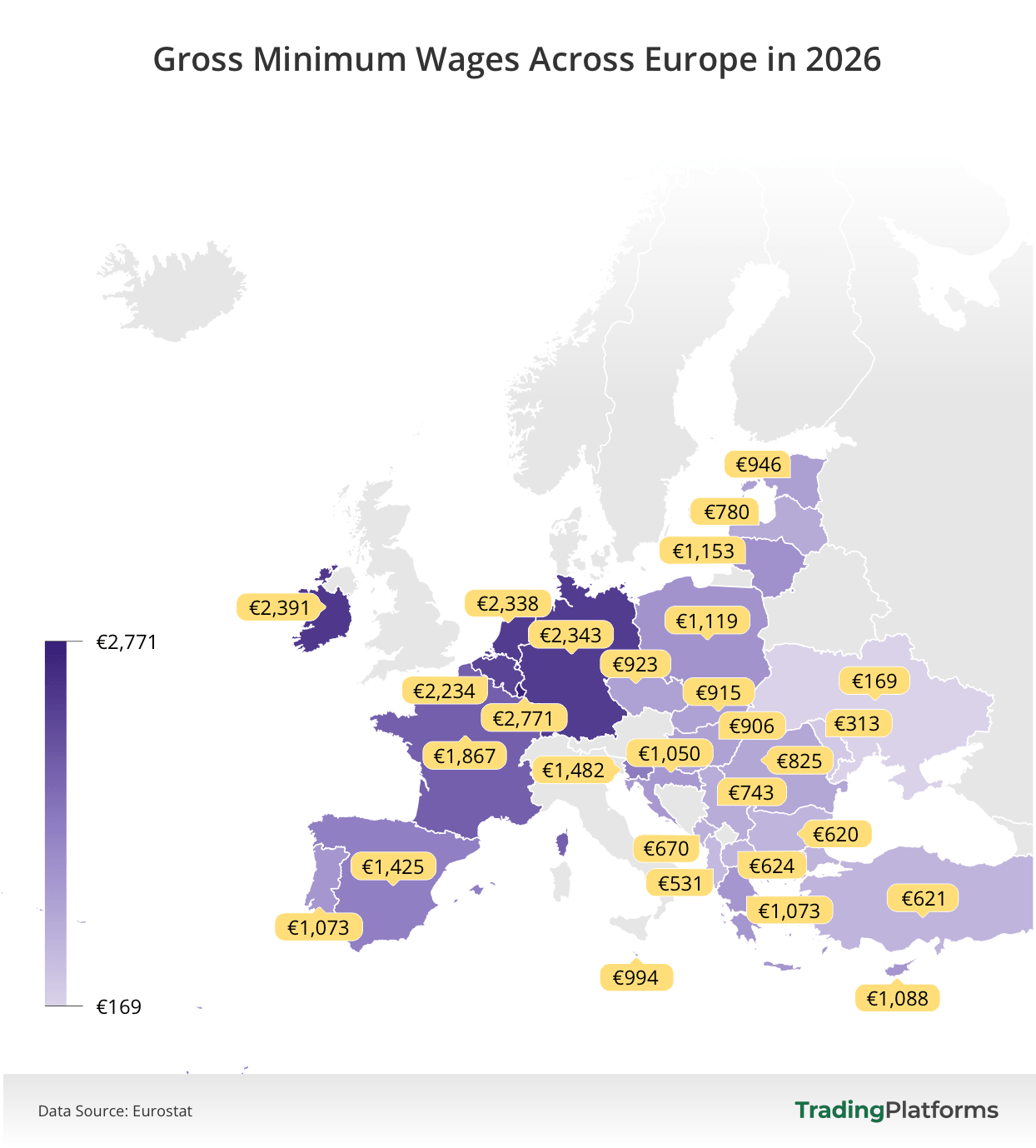
The 2026 map shows how quickly Europe’s wage floor changes across borders. Western European economies largely cluster above €2,000 per month, while much of Central and Eastern Europe sits below €1,500. The middle of the table is also relatively tightly grouped, with 11 countries setting their minimum wage between €900 and €1,200, reflecting the wide variation in minimum pay from one European economy to another.
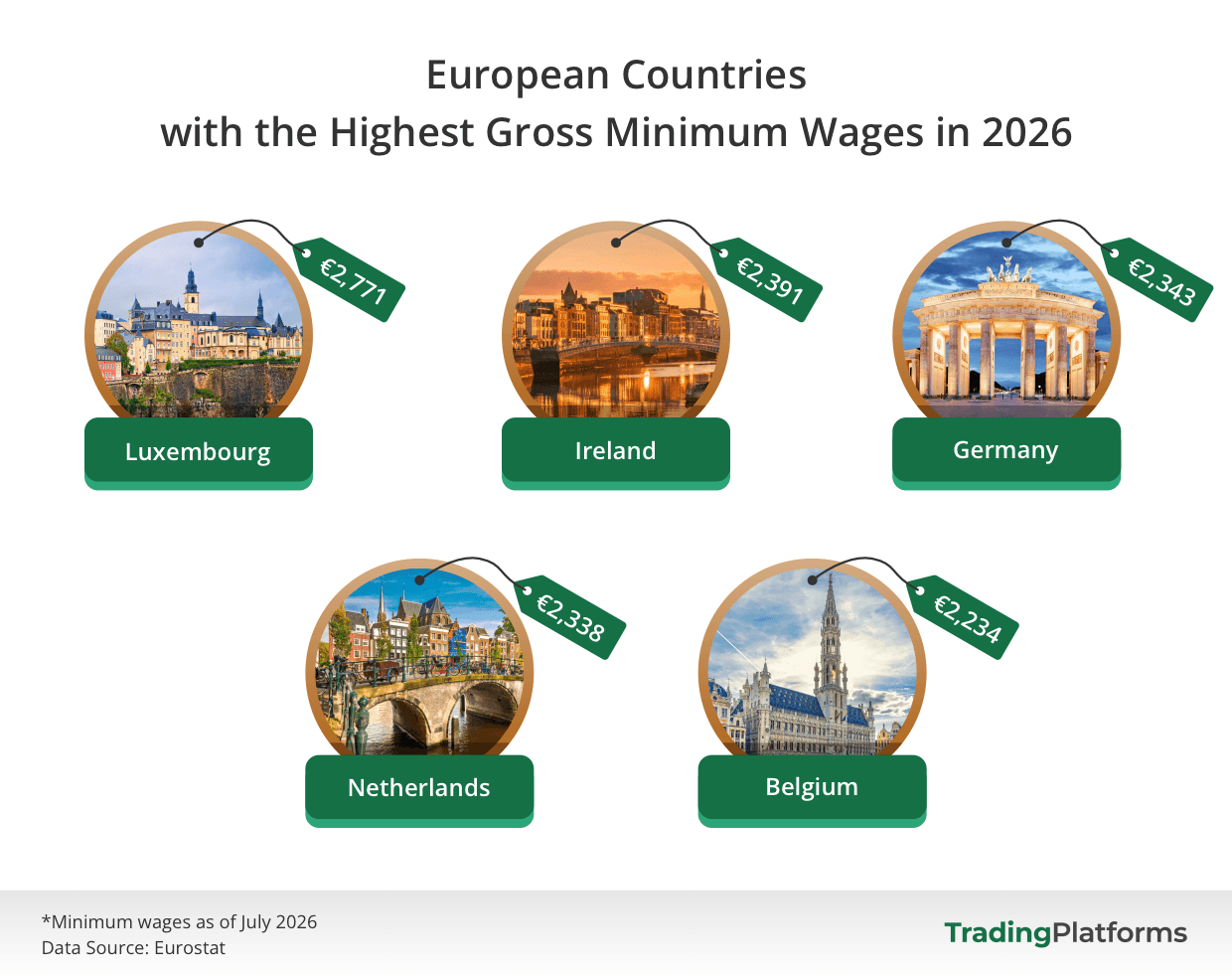
The five highest minimum wages in Europe sit on top of very different labour-market foundations. Luxembourg’s €2,771 wage floor, for example, exists alongside an economy heavily reliant on workers commuting in from abroad with cross-border employees accounting for around 47% of the country’s workforce at the end of 2025. Ireland faces a similar reliance on international labour, with almost 40,000 employment permits for non-EEA workers expected to be issued in 2026, particularly across healthcare, IT, and hospitality. In both countries, a high statutory wage floor is paired with strong demand for workers that domestic labour supply alone cannot fully meet.
Germany faces a different situation – its €2,343 minimum wage ranks among Europe’s highest, yet the Federal Employment Agency recorded 3.061 million unemployed people in August 2026, 54,000 more than a year earlier, and described the labour market as showing ‘little momentum’. The figure shows why a high wage floor cannot, on its own, be taken as a measure of labour-market strength: statutory pay may be rising even as hiring and employment conditions lose momentum.
In the Netherlands, the €2,338 minimum wage is accompanied by major investment in high-value industries, with major chipmaker industry supplier ASML breaking ground on an Eindhoven expansion that could eventually provide space for up to 20,000 workers as demand for chipmaking equipment grows. Here, the challenge is less about the level of the wage floor than the economy’s ability to attract and accommodate the specialised workforce needed to sustain expansion.
Belgium completes the top five with a €2,234 minimum wage, while employer hiring intentions rebounded to +16% for Q4 2026, eight percentage points higher than the previous quarter, according to the employment services company ManpowerGroup. Taken together, the figures point to a labour market where high mandated pay is being accompanied by renewed employer appetite to recruit – a notably different combination from Germany, where similarly high wages are meeting much weaker hiring momentum.
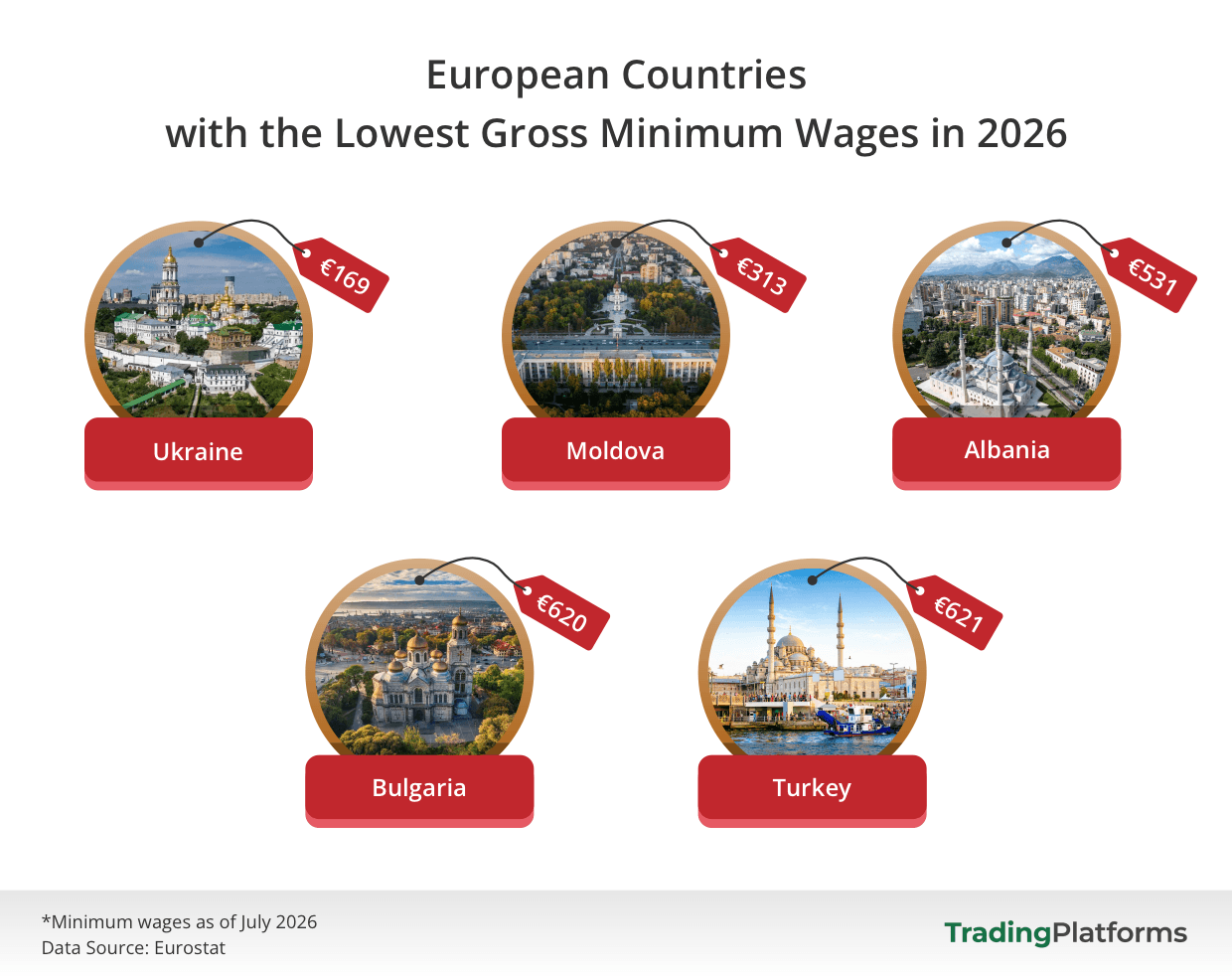
The five lowest minimum wages in Europe in 2026 range from just €169 in Ukraine to €621 in Turkey, but the reasons behind those figures are very different. Ukraine’s €169 wage floor remains by far the lowest in the comparison, as the country’s economy continues to operate under the strain of the war. The National Bank of Ukraine expects GDP growth of only around 1.8% in 2026, after further attacks on energy infrastructure constrained economic activity. Moldova follows at €313, although its labour market has been improving, with employment rising 5.9% between the first and second quarters of 2026 and unemployment falling from 10.4% to 7.3%.
Albania’s €531 minimum wage also comes with a rapidly changing pay landscape: the statutory floor jumped from 40,000 to 50,000 lek in January 2026, while average gross wages were up 9.8% year-on-year in Q2. Next up, Bulgaria stands at €620, making it the lowest-paid EU member in the analysis – a striking wage floor for an economy where labour shortages remain acute in healthcare, industry, and construction, and continue to constrain business expansion.
Turkey rounds out the group at €621, with its 2026 minimum wage rising by 11.3% in euro terms from the previous year (up 27% to TRY 33,030 in local currency). Yet high inflation continues to erode the purchasing power behind the headline increase, making the nominal rise a less complete measure of how workers’ incomes are changing.
Which Countries Raised Their Minimum Wage the Most in the Past Year?
Every annual increase moves the floor beneath Europe’s lowest-paid workers, but the significance of that movement depends on what is happening around it. Governments may raise minimum wages to help earnings keep pace with prices, respond to labour shortages or lift the incomes of workers at the bottom of the pay scale. For employers, however, higher wage floors can also mean greater labour costs and pressure to adjust pay further up the earnings ladder.
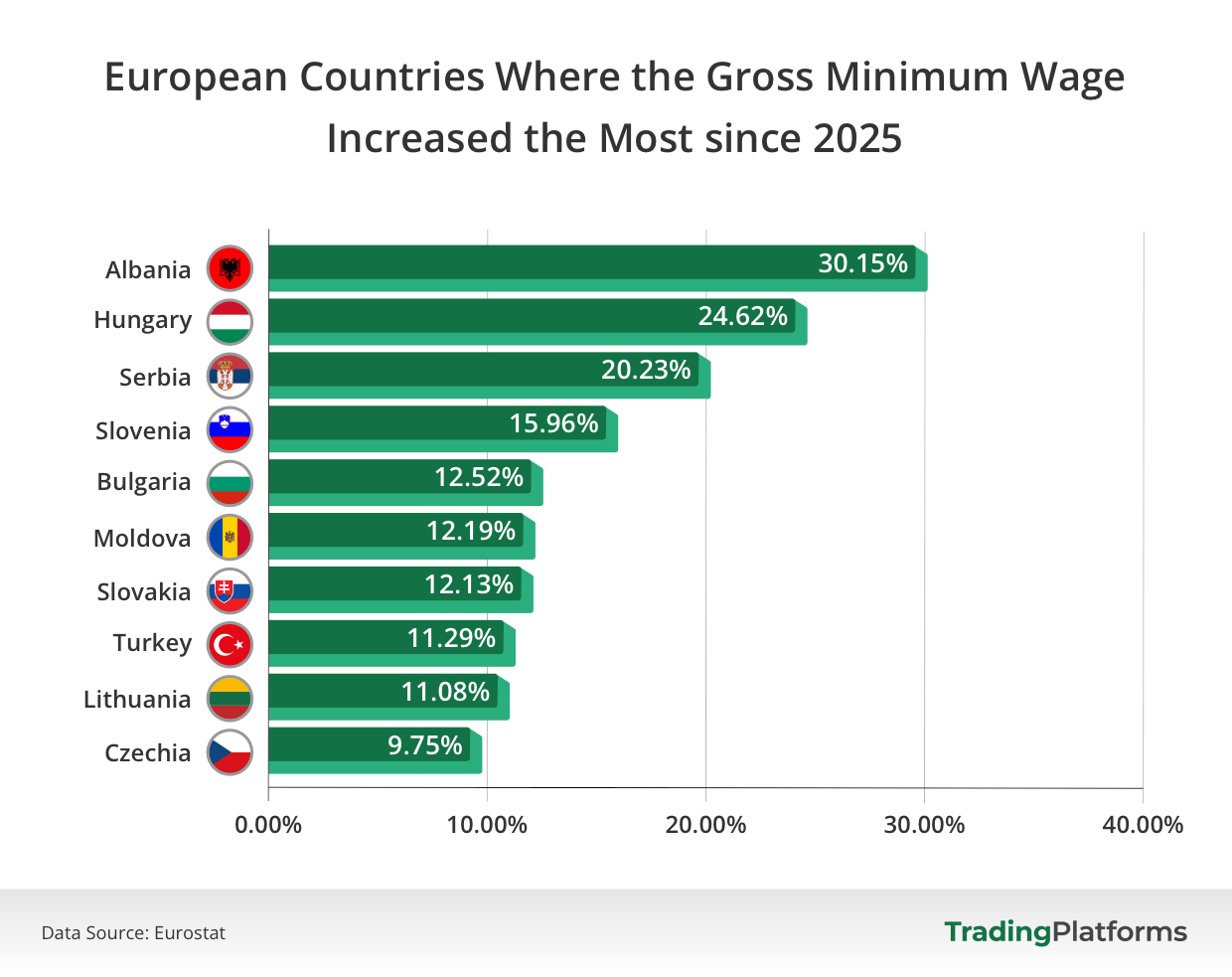
Albania sits well ahead of the field, raising its minimum wage by 30.15% in a single year, from €408 to €531. Hungary and Serbia follow with increases of 24.62% and 20.23%, lifting their wage floors to €906 and €743, respectively. Yet Slovenia offers the more revealing comparison: its smaller 15.96% rise added €204 to the monthly minimum, taking it to €1,482 – more in absolute terms than the faster percentage increases in Albania, Hungary, or Serbia. The contrast shows how the same percentage can carry very different weight depending on where the wage floor begins.
That pattern runs through the figures. Moldova’s 12.19% increase sounds substantial, but it leaves the country with a €313 minimum wage; Bulgaria’s almost identical 12.52% rise takes its floor to €620, while Lithuania’s 11.08% increase pushes its minimum above €1,150. The annual percentage tells us how quickly the floor is moving, while the wage itself tells us how high it has climbed. In 2026, those two measures continue to paint very different pictures of progress across Europe.
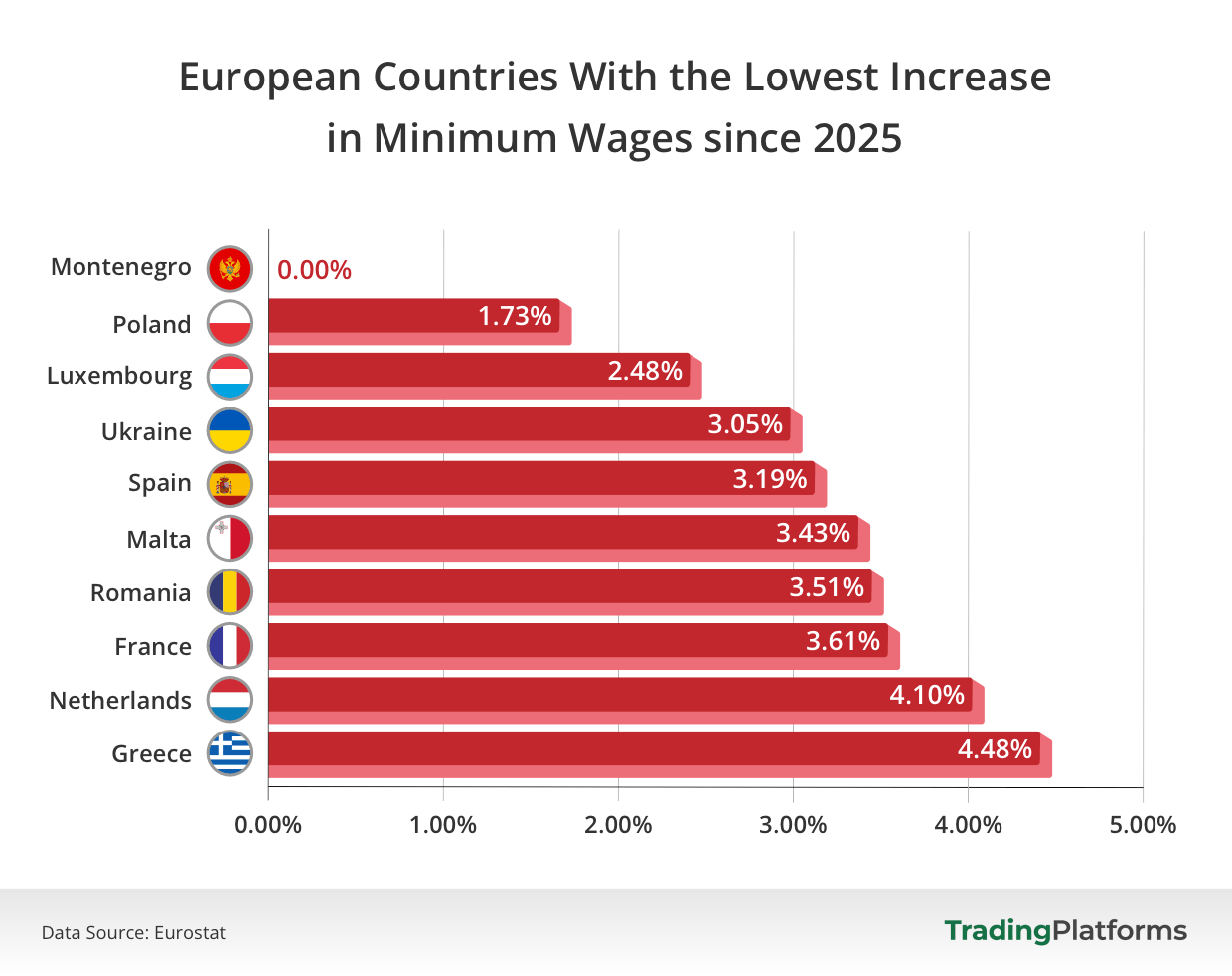
At the bottom of the 2026 growth table, Montenegro is the only country where the minimum wage did not move at all, remaining at €670. Poland recorded the next-smallest increase, with its minimum edging up just 1.73%, from €1,100 to €1,119. Luxembourg follows at 2.48%, although the modest percentage masks a €67 monthly increase, taking its minimum to €2,771 – the highest in the comparison. The Netherlands saw a similarly restrained 4.10% rise, but that still translated into an additional €92 a month, bringing the minimum to €2,338.
The lower end of the ranking also reveals how little a percentage point can tell us on its own. Ukraine’s 3.05% increase amounted to just €5, leaving the minimum at €169, while France’s 3.61% rise added €65 and brought it to €1,867. Spain, Malta, and Romania all recorded increases of between 3.19% and 3.51%, yet those translated into gains of €44, €33, and €28 respectively. The countries clustered around the bottom of the growth ranking are therefore not experiencing the same kind of wage movement: in some, a small increase adds a meaningful sum to an already high income floor; in others, it barely shifts the amount workers can earn.
The Biggest Minimum Wage Increases Across Europe Since 2016
The period from 2016 to 2026 was hardly an ordinary decade for European economies. It began with the aftermath of the eurozone crisis still shaping wage policy, passed through Brexit and a prolonged period of relatively subdued inflation, then collided with the COVID-19 pandemic, the energy shock following Russia’s invasion of Ukraine and the sharpest inflation surge in decades. Labour markets, meanwhile, moved from pandemic disruption to widespread worker shortages, giving governments another reason to rethink how quickly the lowest wages should rise.
Minimum wages became part of that wider economic adjustment. In some countries, increases accelerated as governments tried to prevent the lowest-paid workers from losing ground to rising prices; elsewhere, wage growth remained more restrained. By 2026, the cumulative changes offer a rare numerical record of how differently European economies have travelled through the same turbulent decade – and of how dramatically some of the continent’s lowest legal wages have been repositioned in the process.
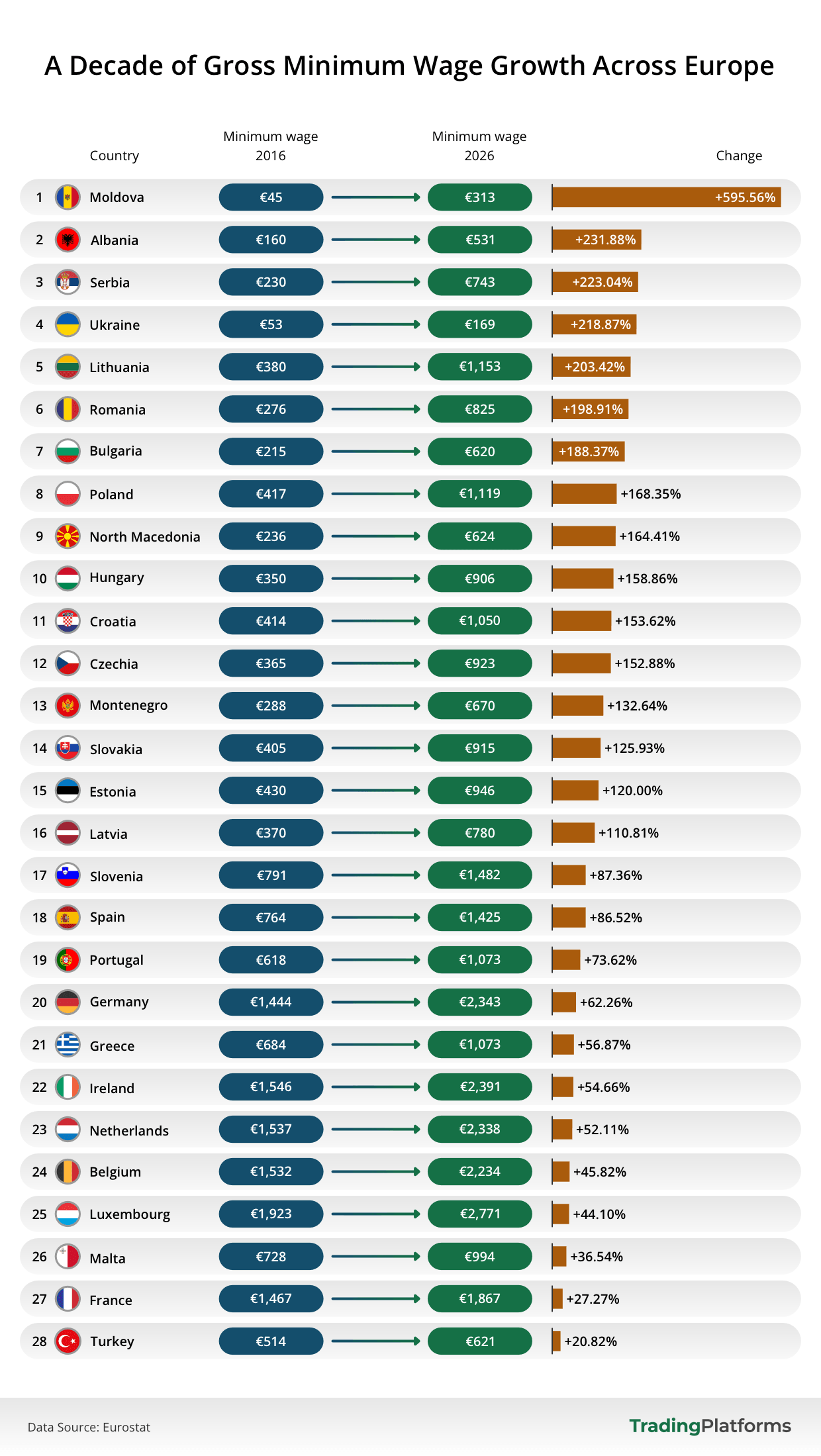
Moldova’s minimum wage underwent the most dramatic transformation of the decade, rising from €45 in 2016 to €313 in 2026 – a 595.56% increase. Yet the figure also exposes the limits of percentage growth: after multiplying almost sevenfold, Moldova’s statutory pay still is Europe’s second-lowest minimum wage. The change looks rather different in Lithuania, where a 203.42% increase carried the statutory minimum from €380 to €1,153, pushing it across the €1,000 threshold. Albania, Serbia and Ukraine likewise more than tripled their pay rates, but their 2026 minima remain at €531, €743, and €169 respectively. The decade has therefore produced some spectacular rates of increase without erasing the very different starting positions from which European wage systems began.
The shift is perhaps clearest at the two extremes. In 2016, Luxembourg’s €1,923 minimum was 43 times higher than Moldova’s €45; by 2026, the ratio had fallen to 9 times. At the top of the table, Luxembourg, France, Belgium, and the Netherlands all recorded comparatively modest percentage increases, but their minimum wages remained comfortably above €1,800. Meanwhile, Turkey’s wage rose by only 20.82% over the decade, reaching €621. Europe’s minimum-wage hierarchy has consequently become considerably less extreme in relative terms, without becoming remotely equal in cash terms.
Methodology:
Countries without a national statutory minimum wage – Denmark, Italy, Austria, Finland and Sweden – were excluded from the rankings. Cyprus was included in the 2025 and 2026 comparisons but excluded from the 2016-2026 analysis because no comparable 2016 figure was available.
Additional official and reputable sources were consulted to add labour-market and economic context to selected country findings. These included government and statistical sources such as Luxembourg’s IGSS, Ireland’s Department of Enterprise, Tourism and Employment, Germany’s Federal Employment Agency, Moldova’s National Bureau of Statistics and the European Commission’s Bulgaria country report, alongside reporting from Reuters and sector-specific sources including ASML and ManpowerGroup Belgium. These sources were used to contextualise the wage data and provide supporting evidence for country-specific developments.